
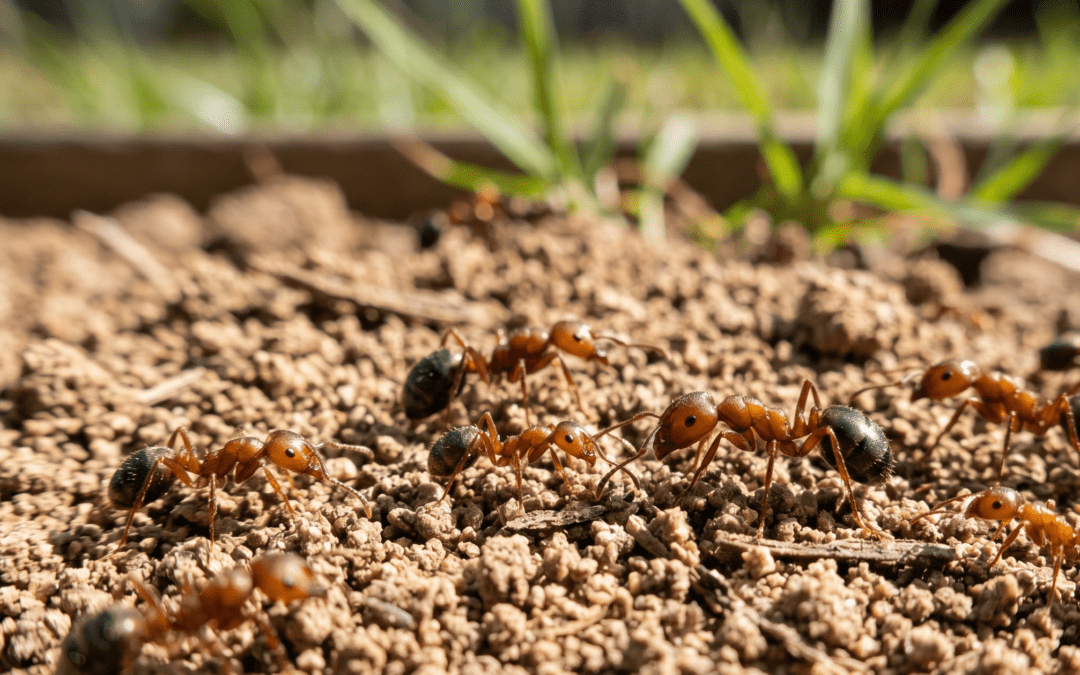
Not every ant in your backyard is a fire ant. Queensland is home to over 1,300 native ant species, and many of them are harmless, beneficial, or both. But when you spot a swarm of reddish ants near a mound of disturbed soil, the question hits fast: are these fire ants or something else?
Getting the identification right matters. Red imported fire ants (Solenopsis invicta) are a legally notifiable biosecurity threat in Queensland. If you have them on your property, you are required to report them within 24 hours under the Biosecurity Act 2014. Mistaking a native species for fire ants wastes time and resources. Mistaking fire ants for a native species can let a dangerous colony grow unchecked.
Here is how to tell the difference.
Why Identification Is Harder Than You Think
In the United States, fire ants are relatively easy to identify because their mounds are large, dome-shaped, and distinctive. In Queensland, fire ant mounds look different. They are often low, flat, and blend into lawns, garden beds, and bare soil. Some have no visible mound at all, appearing as nothing more than a patch of slightly raised or disturbed earth.
This means you cannot rely on the mound alone to confirm a fire ant infestation. You need to look at the ants themselves.
The challenge is that several native Australian ant species share a similar size and colour with fire ants. Without knowing what to look for, it is easy to confuse them.
Red Imported Fire Ants: Key Features
Red imported fire ants have a set of physical and behavioural characteristics that, taken together, make them identifiable in the field.
Size variation within the same colony. This is one of the most reliable identification features. Fire ant workers within a single colony vary in size from about 2mm to 6mm. If you look closely at a group of ants from the same mound and see a clear range of sizes (small, medium, and large workers all mixed together), that is a strong indicator of fire ants. Most native ant species have workers that are uniform in size.
Colour. Fire ant workers are coppery brown on the head and thorax (the middle body section), with a darker brown or black abdomen (the rear section). The overall appearance is a reddish brown body with a noticeably darker back end.
Aggression. Fire ants are highly aggressive when their nest is disturbed. If you accidentally step near a mound or tap it with a stick, fire ants will swarm out in large numbers within seconds and immediately begin climbing and stinging. This rapid, coordinated defensive response is distinctive. Most native ant species will scatter or retreat when disturbed rather than attack.
Sting. Fire ant stings produce a sharp, burning pain followed by the formation of a white pustule within 24 hours. If you are stung by ants from a mound and develop pustules, that is a strong indicator of fire ants. Native ant stings rarely produce this specific reaction.
Mound characteristics. In Queensland, fire ant mounds are typically flat or slightly raised, often found in sunny, open areas like lawns, footpaths, driveways, garden edges, and near infrastructure. The soil on the mound surface often appears finely worked and crumbly. There is usually no visible entry hole on top of the mound. Workers enter and exit through underground tunnels that open at the edges.
Commonly Confused Native Species
Several native ant species in Queensland are regularly mistaken for fire ants. Here are the most common ones and how to tell them apart.
Coastal Brown Ant (Pheidole megacephala)
Coastal brown ants are one of the most common ant species in South East Queensland and are frequently reported as suspected fire ants. They are small (about 2mm to 3mm), brown, and can form large colonies with visible soil disturbance.
How to tell them apart: Coastal brown ants have two distinct worker sizes (minor workers and major workers with oversized heads), but they lack the full range of sizes seen in fire ant colonies. They are not aggressive when disturbed. They do not sting in a way that produces pustules. Their nests often appear as messy piles of soil around pavers, foundations, and garden edges, rather than the smooth, finely worked mounds of fire ants.
Green-Head Ant (Rhytidoponera metallica)
Green-head ants are a native species found throughout eastern Australia. They are slightly larger than fire ants (about 5mm to 7mm) and have a distinctive metallic green or purplish sheen on their head and thorax.
How to tell them apart: The metallic colouring is the giveaway. Green-head ants also nest in small, inconspicuous holes in the ground rather than building raised mounds. They can sting, and the sting is painful, but it does not produce the white pustule characteristic of fire ant stings. Green-head ant workers are uniform in size.
Meat Ant (Iridomyrmex purpureus)
Meat ants are one of Australia’s most recognisable native ant species. They are medium-sized (about 6mm to 12mm), dark with a reddish or purplish tint, and build distinctive gravel-covered nest mounds that can be quite large.
How to tell them apart: Meat ants are significantly larger than fire ants. Their nests are covered in small pebbles, gravel, or leaf litter, which is very different from the smooth, crumbly soil of fire ant mounds. Meat ants do not sting. They bite, but the bite is mild. They are also active during the day and tend to move in well-defined trails, unlike the swarming behaviour of fire ants.
Bull Ant (Myrmecia species)
Bull ants are large (15mm to 40mm), aggressive, and capable of delivering a very painful sting. Their size alone makes them easy to distinguish from fire ants, but they are sometimes reported by people who associate “aggressive stinging ant” with fire ants.
How to tell them apart: Bull ants are dramatically larger than fire ants. They have large, prominent mandibles (jaws) and are usually solitary or found in small numbers rather than in dense swarms. Their nests are often located in bushland rather than open suburban lawns.
Red-Headed Spider Ant (Leptomyrmex erythrocephalus)
These slender, long-legged ants have a red head and dark body. They are sometimes reported as fire ants due to the red colouring.
How to tell them apart: Spider ants are much more slender and leggy than fire ants. They move quickly in an erratic, spider-like manner. They do not sting, do not swarm aggressively, and do not build soil mounds.
The Five-Point Field Test
When you encounter ants on your property and need a quick assessment, run through these five checks.
Check 1: Size variation. Look at a group of workers from the same colony. Are they different sizes? Fire ants have a clear range from 2mm to 6mm within one colony. Most native species are uniform.
Check 2: Colour pattern. Are the ants coppery brown on the front half with a darker rear? This two-tone pattern is characteristic of fire ants.
Check 3: Aggression. Gently tap near the mound with a stick (from a safe distance). Do the ants swarm out aggressively and try to climb the stick? Fire ants attack immediately. Most native ants scatter.
Check 4: Mound type. Is the mound a flat or slightly raised patch of finely worked soil with no visible entry hole on top? Fire ant mounds in Queensland look different from the tall dome mounds seen overseas.
Check 5: Location. Is the mound in a sunny, open area such as a lawn, footpath edge, garden bed, or near infrastructure? Fire ants prefer warm, exposed locations.
If the ants match three or more of these checks, treat the sighting as a suspected fire ant infestation and proceed with reporting.
What to Do If You Think You Have Fire Ants
Do not disturb the mound any further. Disturbing the colony can cause it to relocate, making it harder to find and treat.
Report the sighting to the Queensland Government within 24 hours. This is a legal requirement under the Biosecurity Act 2014.
Arrange for professional identification and treatment. A qualified fire ant control specialist can confirm the species and, if fire ants are present, apply targeted treatment to eliminate the colony.
What to Do If They Are Native Ants
If the ants on your property turn out to be a native species, that is good news. Most native ants are beneficial. They aerate soil, control other pest species, and play an important role in the ecosystem.
In most cases, native ant colonies do not require treatment. If a native species is causing a nuisance (such as coastal brown ants nesting under pavers), standard pest control methods are usually effective.
The important thing is knowing the difference. A few minutes spent checking the identification features above can save you unnecessary worry, or alert you to a serious problem that needs immediate attention.
Do Not Guess When It Comes to Fire Ants
Fire ant identification is not something to get wrong. If you are unsure whether the ants on your property are fire ants or a native species, get a professional opinion. The risk of letting a fire ant colony grow unchecked is far greater than the effort of having it inspected.
Contact Fire Ant Solutions to arrange a property inspection and get a definitive answer on what is living in your yard.